
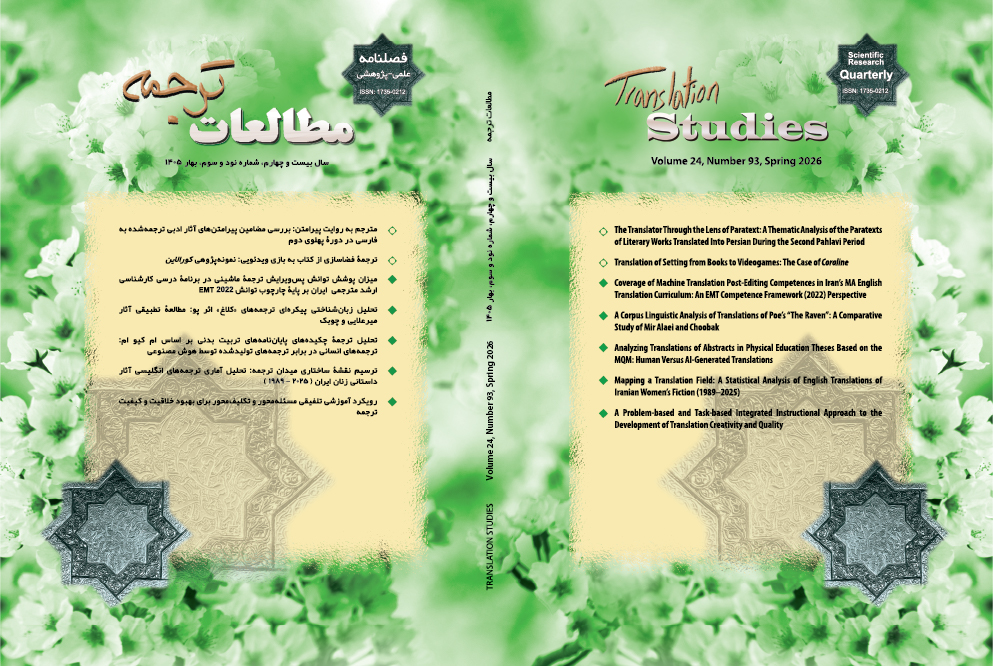
Translation of Setting from Books to Videogames:
The Case of Coraline
Abstract
With the emergence of new technologies in the twentieth century, adaptation stepped into new dimensions. One such dimension is the adaptation of books into videogames. Although the practice of adapting books into videogames dates back at least four decades, most research in this area has adopted a merely theoretical approach, with few data-driven and systematic studies conducted on the subject. This research gap becomes all the more conspicuous when the economic and cultural significance of videogames is taken into consideration. In response, the present study examines the translation of setting from the book Coraline into its videogame adaptation through the lens of multimodal translation. Data collection and analysis were carried out based on the model proposed by Nikolajeva and Scott (2006). First, the features of setting were divided into two categories: spaces and things. Subsequently, the text and images of the book, as well as the full gameplay video, were analyzed to identify instances of these features. The setting features of the book and the game were then compared to determine the degree of correspondence between the two. The results showed that 42% of the setting features of the book were translated into the game, indicating a limited correspondence between the setting of the book and that of the game. Analyzing these findings from the perspective of videogame adaptation, it appears that the game developers, unlike the author and illustrator of the book, incorporated numerous repetitive features, possibly due to time and budgetary constraints. Furthermore, from a multimodal translation standpoint, the setting of the book is not fully recreated in the game; rather, it served primarily as a source of inspiration for the setting of the game.
References
Araújosantos, N. S. (2017). Literature and videogames: Adaptation and reciprocity. Revista Letras Raras, 6(3), 222–232.
Bachelard, G. (1994). The poetics of space (M. Jolas, Trans.). Beacon.
Barr, M. (2020). The force is strong with this one (but not that one): What makes a successful Star Wars video game adaptation? Arts, 9(4), Article 131.
Bassnett, S., & Lefevere, A. (1992). General editors’ preface. In A. Lefevere (Ed.), Translation, rewriting, and the manipulation of literary fame (pp. vii–viii). Routledge.
Bryan, E. (2023). The making of monsters: Thomas Potter Cooke and the theatricaldebuts of Frankenstein and The Vampyre. In L. L. Szwydky & G. Jellenik (Eds.), Adaptation before cinema (pp. 183–211). Palgrave Macmillan.
Chesterman, A. (2021). Virtue ethics in translation. In K. Koskinen & N. K. Pokorn (Eds.), The Routledge handbook of translation and ethics (pp. 13–24). Routledge.
Clement, J. (2024a). Number of video game users worldwide from 2019 to 2029. Statista. Retrieved October 21, 2024 from https://www.statista.com/statistics/748044/number-video-gamers-world
Clement, J. (2024b). Video game industry: Statistics and facts. Statista. Retrieved October 21, 2024 from https://www.statista.com/topics/868/video-games/#topicOverview
Crofts, M. (2023). Videogame adaptation of literary texts and global influences: A case study of Dracula and the Castlevania series. In B. Chua, & E. Ho (Eds.), The Routledge companion to global literary adaptation in the twenty-first century (pp. 37–53). Routledge.
Elliott, K. (2020). Theorizing adaptation. Oxford University Press.
Flanagan, K. M. (2017). Videogame adaptation. In T. Leitch (Ed.), The Oxford handbook of adaptation studies (pp. 441–456). Oxford Academic.
Gaiman, N. (2002). Coraline. PerfectBound.
Gawroński, S., & Bajorek, K. (2020). A real Witcher—Slavic or universal: From a book, a game or a TV series? In the circle of multimedia adaptations of a fantasy series of novels “The Witcher” by A. Sapkowski. Arts, 9(4), Article 102. https://doi.org/10.3390/arts9040102
Gottlieb, H. (1994/2017). Semiotics and translation. In K. Malmkjaer (d.), The Routledge handbook of translation studies and linguistics (pp. 45–63). Routledge.
Hutcheon, L. (2013). A theory of adaptation (2nd ed.). Routledge.
Jellenik, G. (2018). Adaptation’s originality problem: Grappling with the thorny questions of what constitutes originality. In D. Cutchins, K. Krebs, & E. Voigts (Eds.), The Routledge companion to adaptation (pp. 182–193). Routledge.
Jellenik, G. (2023). Adaptation as the art form of democracy: Romanticism and the rise of novelization. In L. L. Szwydky, & G. Jellenik (Eds.), Adaptation before cinema: Literary and visual convergence from antiquity through the nineteenth century (pp. 49–68). Palgrave Macmillan.
Jellenik, G., & Szwydky, L. L. (2023). Introduction: Adaptation’s past, adaptation’s future. In L. L. Szwydky, & G. Jellenik (Eds.), Adaptation before cinema: Literary and visual convergence from antiquity through the nineteenth century (pp. 1–17). Palgrave Macmillan.
Kaindl, K. (2013). Multimodality and translation. In C. Millán & F. Bartrina (Eds.), The Routledge handbook of translation studies (pp. 257-270). Routledge.
Khan, B. (2025). Interactive digital narrative in video gaming: A multimodal investigation [Doctral dissertation]. Charles Sturt University.
Kress, G., & van Leeuwen, T. (2001). Multimodal discourse: The modes and media of contemporary communication. Arnold.
Kudláč, M. (2019). Transmedia storytelling: The many faces of video games, fluid narratives and winding seriality. In D. Callahan, & A. Barker (Eds.), Body and text: Cultural transformations in new media environments (pp. 191–203). Springer.
Kulmala, V. (2021). “We’re Meant to Choose”: Thematic Changes in Video Game Adaptations of Non-Participatory Media [Master’s Thesis, Tampere University]. Tampere University.
Matek, L., & Prtenjača, Z. (2023). Neil Gaiman’s Coraline: A gothic bildungsroman. Libri et liberi, 12(2), 275-291. https://doi.org/10.21066/carcl.libri.12.2.3
Mäyrä, F. (2023). Culture. In M. J. P. Wolf & B. Perron (Eds.), The Routledge companion to video game studies (pp. 370–377). Routledge.
Mejías-Climent, L. (2021). Enhancing video game localization through dubbing. Palgrave Macmillan.
Neamah, H. K. (2023). Multimodality as an approach to video games advertisement. Kurdish Studies, 11(2), 1175-1180. https://doi.org/10.58262/ks.v11i02.081
Nikolajeva, M., & Scott, C. (2006). How picturebooks work. Routledge.
Ortiz de Gortari, A. B. (2015). Exploring game transfer phenomena: A multimodal research approach for investigating video games’ effects [Doctoral Dissertation]. Nottingham Trent University.
Patience, S. (2022). When did the video game industry overtake Hollywood and the music industry? Driverless Crocodile. Retrieved October 19, 2024 from https://www.driverlesscrocodile.com/sustainability-and-change/when-did-the-video-game-industry-overtake-hollywood-and-the-music-industry/
Randall, N. (2017). Source as paratext: Videogame adaptations and the question of fidelity. In C. Miller, & A. Kelly (Eds.), Emerging genres in new media environments (pp. 171–185). Palgrave Macmillan.
Sanchez, J., Saenz, M., & Garrido, J. M. (2010). Usability of a multimodal video game to improve navigation skills for blind children. ACM Transactions on Accessible Computing, 3(2), Article 7. https://doi.org/10.1145/1857920.1857924
Sanders, J. (2016). Adaptation and appropriation (2nd ed.). Routledge.
Smith, M.-A. (2023). A classical drama of human bondage: Recurrent replications of supplication, appeals, and social justice activism from antiquity through the present. In L. L. Szwydky, & G. Jellenik (Eds.), Adaptation before cinema: Literary and visual convergence from antiquity through the nineteenth century (pp. 21–47). Palgrave Macmillan.
Stam, R. (2000). Beyond fidelity: The dialogics of adaptation. In J. Naremore (Ed.), Film Adaptation (pp. 54–76). Rutgers University Press.
Stamenković, D., & Wildfeuer, J. (2021). An empirical multimodal approach to open-world video games: A case study of Grand Theft Auto V. In J. Pflaeging, J. Wildfeuer, & J. A. Bateman (Eds.), Empirical multimodality research: Methods, evaluations, implications (pp. 259–279). De Gruyter. https://doi.org/10.1515/9783110725001-011
Tavinor, G. (2009). The art of videogames. Wiley-Blackwell.
Toh, W. (2019). A multimodal approach to video games and the player experience. Routledge.
Touiserkani, F. (2015). Politeness in adaptation of Persian multimodal texts: The case of “Half Life 2” videogame. Procedia: Social and Behavioral Sciences, 192, 796–802. https://doi.org/10.1016/j.sbspro.2015.06.098
Zagalo, N. (2019). Multimodality and expressivity in videogames. Observatorio, 13(1), 86–101. https://doi.org/10.15847/obsOBS13120191411
Downloads
Published
Versions
- 2026-09-03 (3)
- 2026-09-03 (2)
- 2026-09-01 (1)
How to Cite
Issue
Section
DOR
License
Copyright (c) 2026 Ali Namazi, Fatemeh Parham

This work is licensed under a Creative Commons Attribution-NonCommercial 4.0 International License.
Copyright Licensee: Iranian Journal of Translation Studies. This article is an open access article distributed under the terms and conditions of the Creative Commons Attribution–NonCommercial 4.0 International (CC BY-NC 4.0 license).